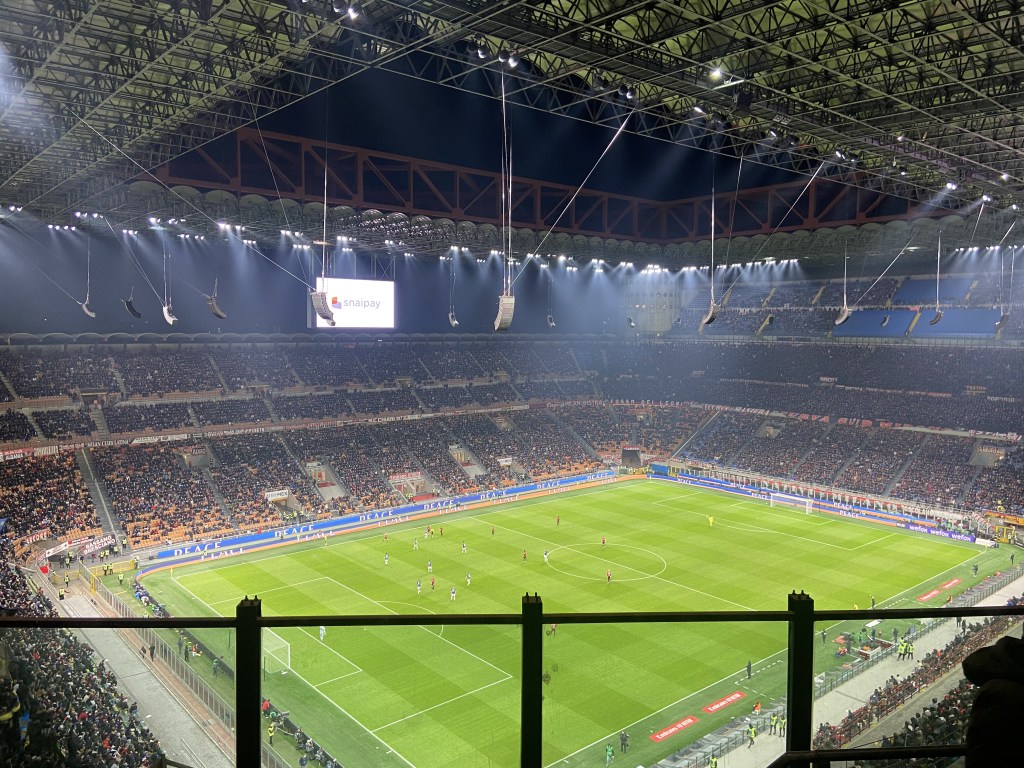
Football coverage is swamped in conflict connotations and nationalist rhetoric. Think about it, how many times have you heard of a relegation scrap, a title clash or teams battling it out to win? When is a nation at its peak level of harmony? Prior to a match at an international sporting tournament before it all inevitably falls apart and we turn against our battle-hardened warriors. This language has become so commonplace that it has slipped into our subconscious, particularly in the UK. But in a world where we are seeing real conflict and nationalist aggression in countries like Ukraine, Syria and Ethiopia, journalists must be more sensitive. After all, it is 2023 not 1943.
The close relationship between sport and conflict was eloquently explained by George Orwell in 1945, a time when one of the world’s largest conflicts was coming to an end. Writing in the Tribune, Orwell argued that “Serious sport has nothing to do with fair play. It is bound up with hatred, jealousy, boastfulness, disregard of all rules and sadistic pleasure in witnessing violence. In other words, it is war minus the shooting.”
Whilst slightly on the strong side, Orwell’s words ring true. Now in the 21st century, Lavric et al’s Linguistics of Football book discovered that previous knowledge of conflict is deeply linked with football language, football reasoning and probably football itself. Marcin Lewandowski’s extensive 2011 study concluded that whilst Polish and English football reporting discourses are both permeated with the rhetoric of violence, the rhetoric of conflict is even more pervasive in English journalistic reporting.
One need only look at recent coverage of domestic football to see this in action. “Brave battlers” were the subject of a recent Football Cliché’s podcast. On the 3rd January, France24 wrote that Arsenal were held by “battling Newcastle”. It can even be seen on a local level. The Isle of Thanet news reported on how Ramsgate won their “top of the table clash”. If you look hard enough, conflict language is everywhere in football reporting.
This conflict language in football is seen strongly in international football coverage, particularly around discourses on nationalism. Why? Because international football brings nationalist language on a larger scale thanks to pride around national identity. A key aspect of nationalism centres around promoting a nation’s greatness compared to others. It aims at creating a feeling of us versus them. In football, we see this nationalist discourse strongest at times of international competition for both journalists and fans. Alan Bairnier wrote that “Except in times of war seldom is the communion between members of the nation, who might otherwise be classed as total strangers, as strongly felt as during major international events”.
Whilst much of football’s nationalist rhetoric is what Michael Billig coined “banal nationalism”, elements of hot nationalism often creep into football. The relationship between football and differing levels of nationalism is nothing new. In 1966, the year of England’s sole World Cup victory, the final against West Germany was surrounded by nationalist rhetoric in the media. In fact, victory celebrations in 1966 were regularly compared to VE Day, and the chant “two world wars and one world cup” became a staple of future matches between England and Germany and a strong symbol of English nationalism. Despite pleas from across the game, fans still sing the song along with the “10 German bombers” chant, including in the game between England and Germany at Euro 2020. In 2000, Daily Mail journalist Vincent Mulchrone once again pulled out the “If Germany beat us at Wembley this afternoon at our national sport, we can always point out to them that we have recently beaten them twice at theirs” line in his column prior to England meeting Germany in a qualifier match. A burning nationalist desire to prove that no matter what England remains ahead of Germany still dominates modern football rhetoric, a prime example of nationalism in action.
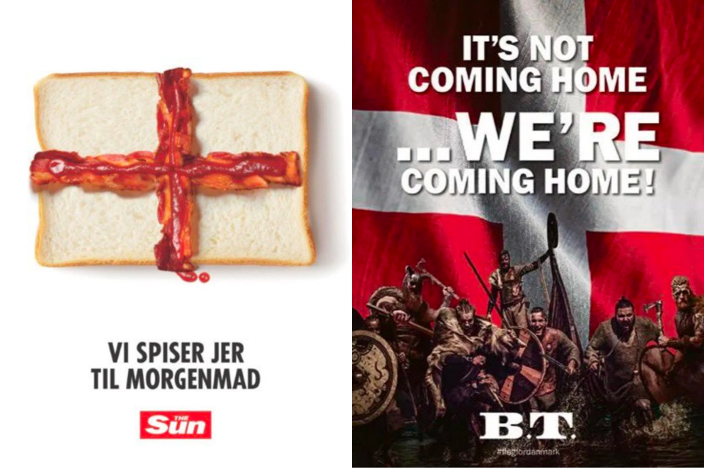
This nationalist element isn’t just linked to war. Ahead of the Euro 2020 semi-final between England and Denmark, UK tabloid The Sun published a full page advert in Danish tabloid BT claiming “vi spiser jer til morgenmad” (we eat you for breakfast). The advert was complete with a St George’s cross made by 2 pieces of bacon on a piece of white bread, with a smattering of ketchup blood for good measure. BT retaliated with their own advert in The Sun, proclaiming “It’s not coming home…we’re coming home!”. The provocative pieces were cheap attempts to amp up banal nationalism to something more against the day’s rivals and foster a strong sense of us versus them. With these moves, media professionals fuelled nationalist fires.
As recently as the Qatar World Cup in 2022, which was controversial in its own right, English football fans embarrassed themselves with their own displays of nationalism. Groups were banned from stadiums for wearing Crusader outfits seemingly not understanding why their outfits may cause offence. Some journalists appeared just as shocked. Sure, nationalism will be rife around sporting events, but journalists should not spark debate around sensitive issues for the sake of national pride and football support.
The use of conflict and nationalist language cannot be blamed solely on football and journalists. Society and politics play a key role. Citizens are constantly pitched against each other and encouraged to fight for their rights. In the UK, we constantly see Right versus Left, Remain versus Leave, North versus South. Now that journalism relies more than ever on audience revenue, journalists are left with no option but to appeal to their audiences and give them content they want to read.
Can journalists do better in their language used around football reporting? Yes. Of course journalists can’t report on international football without an element of nationalism as it is literally one country versus another. Clearly the conflict and stronger nationalist angle sells, but journalists could select other aspects of a story to make them more salient, rather than strong nationalism. Perhaps football journalism’s shift to heavily focused on stats including the introduction of xG (Expected Goals) and xA (Expected Assists) is a step in the right direction. Outlets now pride themselves on their deep dive and long read content, but does this content work for an outlet not purely focused on sport? Even if it does, with recent reporting it does not appear that nationalist and conflict discourses will disappear anytime soon.
 Between the Lynes