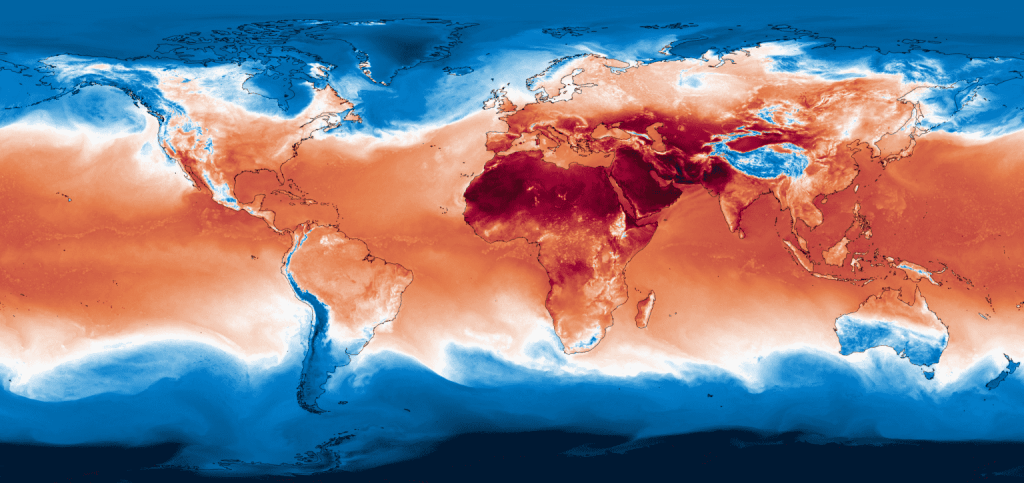
The EU’s DestinE project uses a digital twin of the Earth to predict short-term weather extremes. But can and should it guide long-term climate strategies?
s AI advances, digital twins of everything from cities to aircraft to the human body are helping to predict real-world problems and optimise solutions. Now, the EU is working on cloning something even bigger: the Earth itself.
The European Commission’s Destination Earth project (DestinE) went live on 10 June this year, creating two digital twins – one focused on weather-induced extremes and the other on climate change adaptation.
“It’s not that often that one gets a sneak peek into the future,” Commissioner Margrethe Vestager said at the launch event.
A digital twin is a virtual replica of an object, used to simulate a range of potential situations and outcomes. These simulations are powered by data and machine learning models, leading to ongoing debate around their reliability and suitability for decision-making.
Improved computing and AI have made digital twins increasingly common across a range of sectors. But DestinE aims to surpass the capabilities of other digital twins. The Commission plans to add new twins by 2027, and by 2030 to combine them into a complete simulation of Earth’s climate.
“The aim is to provide science-based information at the highest possible level of detail, from a global to local scale,” Irina Sandu, project director at the European Centre for Medium-Range Weather Forecasts (ECMWF), told The Parliament.
Potential applications include optimising the placement of renewable energy facilities and modelling the impact of climate policies.
This all comes at a cost. The project relies on Europe’s limited high-performance computing resources and demands huge quantities of data. The question is whether it can justify this cost by delivering new long-term insights on climate change, or whether it’s just a very expensive toy for the EU to show to the world.
Use cases
The DestinE system integrates data from the project’s partners, the Copernicus monitoring system, and more generic sources like the Internet of Things. The goal is to feed machine learning models with comprehensive data, recreating past conditions to predict future events.
Read the full piece on The Parliament here.
 Between the Lynes