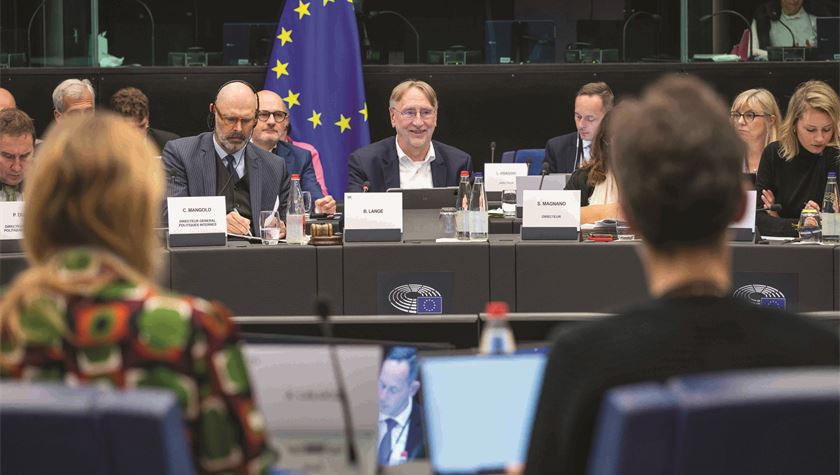
MEP Bernd Lange, Chair of the Conference of Committee Chairs, discusses the importance of the European Parliament’s committees and his role in streamlining EP decision-making.
The balance of power in the European Union has shifted to the right, changing the face of the EU and its institutions.
Amid these changes, work goes on within the 24 committees of the European Parliament. Committee debate remains the lifeblood of much EU legislation.
The Conference of Committee Chairs (CCC) is responsible for the effective functioning of all committee work. The chair of each committee sits on this “committee of committees,” which meets on the Tuesday of every Strasbourg session.
Part of the CCC’s work involves developing the draft agenda for plenary sessions, which they submit to the Conference of Presidents. This ensures that draft legislation complies with treaty rules on delegated implementing acts.
The chair of the CCC is elected every two and a half years. The position is currently held by Bernd Lange, a six-term MEP from the German Social Democrats, part of the S&D group.
‘Fully-fledged parliament’
“There’s no doubt about it, it has really strongly increased — the power of the Parliament,” Lange tells The Parliament.
First elected in 1994, Lange is committed to European integration. From expansion efforts to economic challenges, he has witnessed significant changes.
“When I started, we just had the first co-decision legislation in some sectors,” he says. “Now, more or less in all political fields, we are a co-legislator, and we also now have the power for the ratification of international agreements.”
“We are a fully-fledged Parliament,” he adds.
The EP has considerably more power to introduce and shape legislation, to the extent that “if we have a legislative initiative report with an absolute majority, [the Commission is] committed to bring legislation forward,” Lange says.
The hearings for Commissioners-designate are another area where Lange identifies the EP as successfully extending its powers.
“This is not foreseen in the treaties, but we fought for that. Nowadays, it’s a model to have a proper scrutiny of a candidate for being a commissioner,” he says.
The EP’s committees operate differently than their national counterparts. Legislative work occurs as an entire institution, as opposed to a smaller group of decision-makers.
“We are looking in-depth on legislation, on concrete amendments, discussing between the political groups based on facts and not on supporting a government or being the opposition,” Lange says.
Other parts of EU machinery, however, still wield more power than the EP. The European Council, he says, often has faster access to relevant documents than the EP. This can constrain the EP’s ability to hold the European Commission to account.
“Sometimes, the Commission is trying to use instruments which are limiting the full power of the committees, like urgency procedures,” he says.
Read the full piece on The Parliament here.
 Between the Lynes