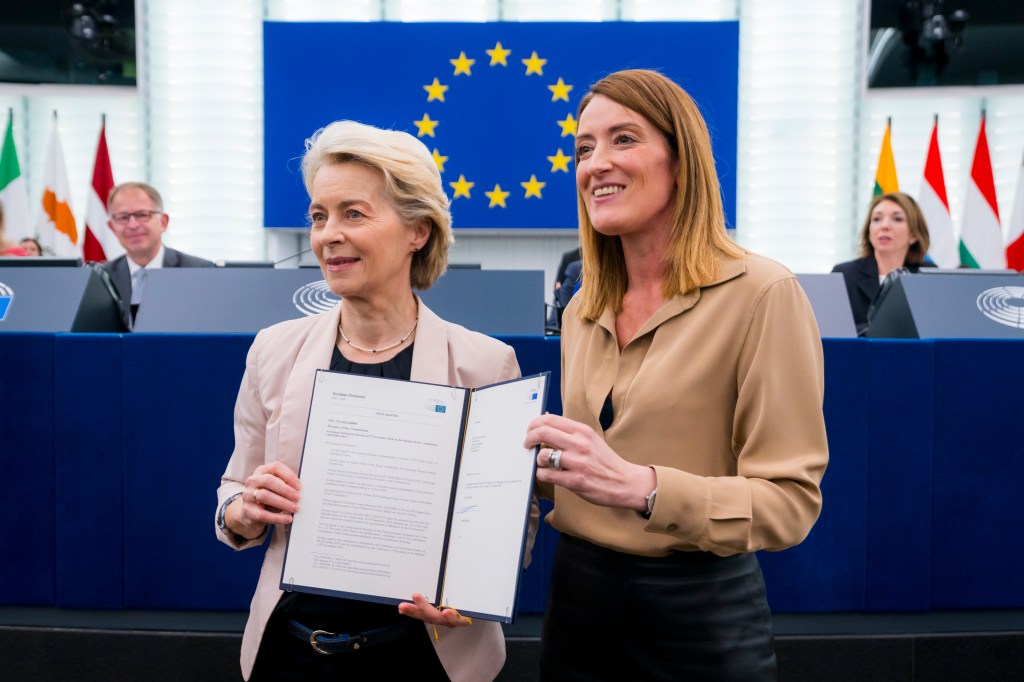
Von der Leyen’s leadership reshaped the European Commission during an era of pandemic, war, and energy instability, but at what cost to democratic balance and the role of the European Parliament?
The last five years of EU politics have seen no shortage of crisis. When Ursula von der Leyen stepped into her first term as European Commission president, Brexit was reaching its climax and the migration crisis was still ongoing. Then came the COVID-19 pandemic, war and inflation.
Von der Leyen has been able to use these extraordinary circumstances to consolidate her own power, and that of the executive she leads.
This political manoeuvring earned her Forbes’ “World’s most powerful women” two years in a row. It also saddled her and her college of commissioners with scandal — something she was no stranger to in her previous role as German defence minister.
Now, von der Leyen enters her second mandate leading a Commission which, if anything like her first, will be unafraid to act.
“You never thought that the institution that has been described as being overly bureaucratic, slow, full of inertia and decisions by consensus will never move quickly,” Dharmendra Kanani, spokesperson for Friends of Europe, an EU-focused policy think tank, told The Parliament. “And suddenly — bang.”
Sidelining the EP
During her first term, the Commission sometimes acted almost omnipotently. Going beyond its traditional role of proposing legislation, it seized special powers allowing it to pass legislation it saw as essential to getting the bloc through the pandemic and the economic downturn it caused.
Critics called out the Commission for what they viewed as sidestepping democratic checks and balances. An executive, however, can almost always act faster than hundreds of lawmakers in the legislative branch.
“If there is a lot of time pressure, like a crisis situation, then I guess mistakes happen, but that is to some extent unavoidable,” Stefan Lehne, a senior fellow at Carnegie Europe, told The Parliament. “In an urgent situation, you have to move much more quickly.”
The Commission’s speed was grounded legally in Article 122 of the Lisbon Treaty, which forms the constitutional basis of the EU. The article permits the EU to adopt swift, exceptional measures in situations of economic emergency or natural disasters. By vesting more legislating power in the European Council and Commission, the measure sidelines the European Parliament — the only body directly elected by EU citizens.
For lawmakers, its increased use is a worrying sign.
“The Commission is trying to use instruments which are limiting the full power of the committees, like urgency procedures,” Bernd Lange, chair of the EP’s Conference of Committee Chairs, told The Parliament, referring to Article 122, which he called “not a favoured procedure.”
The EP’s Committee on Constitutional Affairs has announced it will give Article 122 more scrutiny in the new mandate, to ensure it is not being used as a power grab. In an op-ed for The Parliament, committee chair Sven Simon argued that the Commission must be obliged to justify its use of the article to the EP.
Rule-of-law advocates have called for similar transparency.
“The Commission and the Council have not produced an annual report, nor supported independent review, in respect of the rule of law situation at EU level,” a recent report by the Democracy Institute at Central European University found.
Read the full piece on The Parliament here.
 Between the Lynes