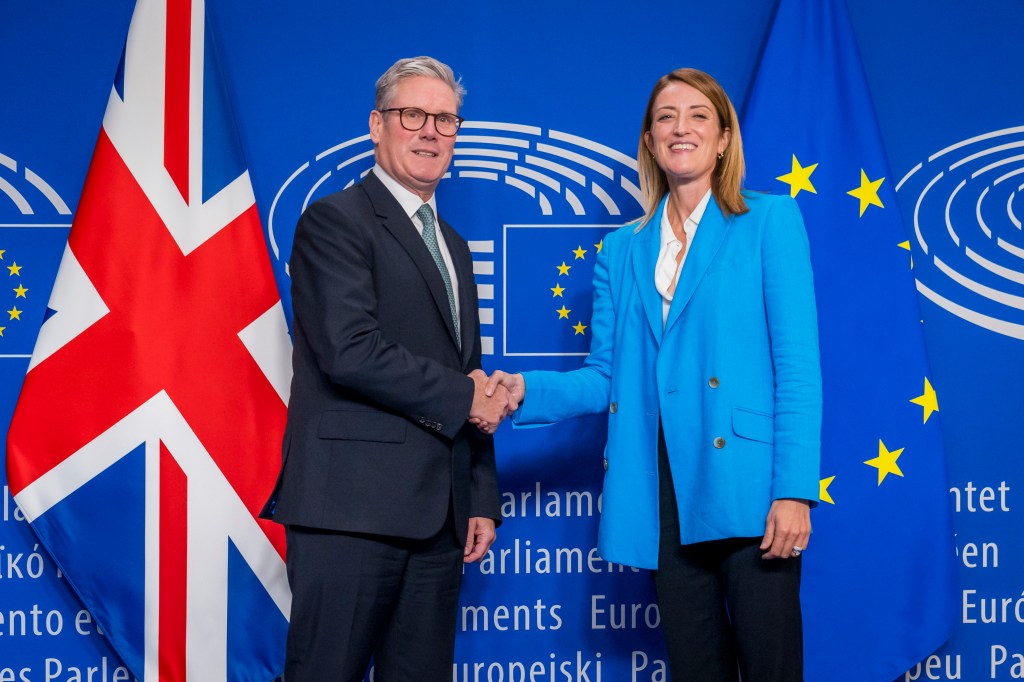
For Europeans on both sides of the English Channel, the Russian threat feels closer and the US presence further away. The post-Brexit urgency to cooperate on defence could lead to better EU-UK relations.
In the five years since the United Kingdom left the European Union, the Brexit legacy has become just one of several pressing geopolitical dramas. From the pandemic to Russia’s full-scale invasion of Ukraine, the UK-EU divorce has made it harder to unite on issues concerning both sides.
The UK’s Labour government, in place since July and the country’s first since 2010, wants to change that. Prime Minister Keir Starmer has promised to “reset” the relationship. After more than six months in office, however, what that looks like in practice remains a mystery.
The EU has made its position clear, but Starmer faces a tougher balancing act. He must look to appease the Leave voters his party won over in the last election while addressing the European enthusiasm from much of Labour’s traditional base.
Shoring up common defence
Proposals such as freedom of movement schemes and some kind of return to the EU’s single market have been rejected by the new government. Defence, on the other hand, is the “low hanging fruit” for cooperation, David McAllister, chair of the European Parliament’s Foreign Affairs Committee, told The Parliament.
The UK may be out of the EU, but it joins 23 EU members as part of the Euro-Atlantic NATO military alliance. That creates significant policy overlap, especially as the EU has expressed more interest in taking on greater responsibility for its own security.
Discussions are ongoing around the European Defence Industry Programme (EDIP), while the EP’s subcommittee on security and defence has been upgraded to a full standing committee.
The EU, conceived foremost as an economic area, could learn from the UK’s long history of warfighting. When it left the EU, it left France as the bloc’s only nuclear-armed and major military power.
A clearer and shared sense of danger has given the UK and EU more reason to work together. The UK was an early target of covert Russian action against Western interests, such as nerve-agent poisonings, cyber attacks and Russian involvement in democratic processes like Brexit. These kinds of incidents have become more common in the EU.
“If we take collective responsibility on procurement as allies in Europe, rather than as individual nations, we will be in a much stronger place to deter any possible aggressor,” Helen Maguire, the UK Liberal Democrats’ defence spokesperson, told The Parliament.
The UK is not as detached from the EU as Brexit fans might like to think. No amount of legislation or regulation can change geographic realities, a factor that weighs on relations between the two players.
“The United Kingdom is not an island. It has a land border with a member state,” Jonathan Faull, the chair of European public affairs at Brunswick Group, a policy advisory, and former Director General of the Task Force for Strategic Issues related to the UK Referendum told The Parliament.
The border between the UK’s Northern Ireland and the EU’s Republic of Ireland was one of the most contentious issues during Brexit negotiations. The Northern Ireland Protocol and Windsor Framework were both adopted to avoid a hard border between the two, a key component of the Good Friday agreement that ended decades of violence.
Read the full piece on The Parliament here.
 Between the Lynes