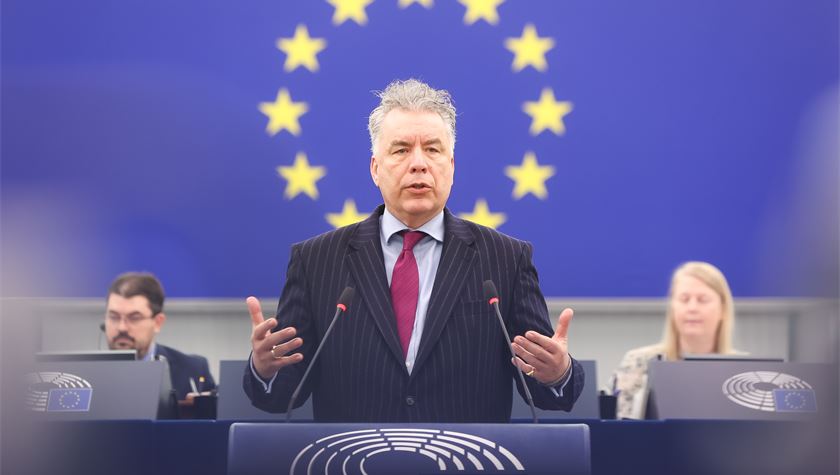
As the CID aims to align climate goals with manufacturing growth, MEP Christian Ehler wants to make sure Europe’s industry has its voice heard in the legislative process.
Since the turn of the millennium, Europe’s industry has been through turmoil. Recessions, pandemics and war have harmed businesses just as they were trying to reconfigure their operations to reduce their climate impact including, since 2019, meeting new requirements under the EU Green Deal.
Now politics has swung to the right and the European Commission wants to help businesses recover their competitive edge – while still reducing their climate impact. The Clean Industrial Deal (CID), proposed in February, “outlines concrete actions to turn decarbonisation into a driver of growth for European industries,” the Commission says.
Pro-business politicians have celebrated the CID’s drive for competitiveness, while those more environmentally minded have expressed concern that the legislation could, despite the cake-and-eat-it rhetoric, ultimately water down decarbonisation efforts.
The political fight, in other words, is far from over. The European Parliament’s work on the CID will be led by the Committee on Industry, Research and Energy (ITRE), in a nod to the EU’s competitiveness commitments.
One person who will be at the heart of the Parliament’s action on the CID is the German MEP Christian Ehler. Ehler is the ITRE coordinator for the centre-right EPP group, the largest group in the parliament that is traditionally pro-business and was sceptical of some of the Green Deal’s more ambitious elements.
For Ehler, the CID is shaping up to be the most consequential chapter in his storied career across business and politics. Currently serving a fifth consecutive term as an MEP, Ehler previously held senior management positions in businesses across several sectors in Germany. So he knows what businesses want – and in his view, they’ve been held back by a lack of investment in the EU Single Market.
“We haven’t been investing a lot in the last two decades into the common market and that has an effect,” Ehler told The Parliament in an interview. “We have been falling far behind our expectations and the potential for the common market. I think this is a discussion where we really have to go radical and it will be a painful discussion.”
Businesses from a wide range of sectors in Europe say the common market is still too fragmented, which has discouraged investment. While much legislation is set at a European level, differences between internal policies in member states can create issues.
Europe’s energy grid, which is at the heart of the CID, is a pertinent example. Despite the Baltic states joining the European energy grid earlier this year, the system is still fragmented and faces interconnectivity issues between member states. This means Europe only uses half of its grid potential, according to the Commission.
For Ehler, the EU institutions have over-regulated, tangling businesses in so much red tape that they’re unable to invest or innovate. “This kind of imperial overspread in terms of ambitious regulation kills the baby in the cradle,” he says.
Less burden, more buy-in
The CID aims to reduce the regulatory burden, with a particular focus on overlapping and contradictory requirements, to create greater simplicity for businesses. For example, it calls for simplification in the EU’s common energy market to remove many of the issues around permitting and licensing.
That should, in theory, make life easier for businesses without reducing regulatory standards – which has created a sense of optimism and momentum among lawmakers, Ehler says: “The Parliament is more aligned than I thought.”
But when asked how this alignment looks in practice, traditional splits appear. “There is a sense of realism in terms of how much, let’s say, a clean industrial deal is needed in order to make either, from a green perspective, the Green Deal possible or from a more competitiveness or growth-driven perspective to have a realistic perspective for the European economy,” Ehler added.
If the CID resembles a triangle with competitiveness, CO2 reduction and general sustainability forming the three sides, the relative weight given to each of these is still very much up for debate.
“I think it is a very problematic triangle because if you put an emphasis on everything at the same time, nothing is going to work,” Ehler says. He favours an approach that focuses on areas that can improve all three sides simultaneously: “Deepening of the energy market, the digital market with all its interconnection to the other issues, and then the fragmented capital market.”
The energy market in particular is closely linked to much of the legislation within the Green Deal. For Ehler, the consequences of getting it wrong would be catastrophic: “If we don’t have a common energy market in Europe, the Green Deal is going to fail,” he argues.
Read the full piece of The Parliament here.
 Between the Lynes